Sunday, 23 October 2011

Again into Angola


And they moved on to the Angolan side. From the time they passed in 2008, there was a slight change. At the boom, there were new buildings where they registered the passports and then they drove on to where they did all the paperwork in 2008. There they found that more buildings have been built in the meantime and they had proper offices with aircon and even buildings to house the staff who work there.

There started a long wait. The immigration officers asked a few questions and the passports went to their chief. They were back with a few more questions from their chief and they waited further. The passports came back and it took them ages to just stamp them. In the meantime they stopped dealing with the passports and dealt with some locals, answered phone calls, discussed with other colleagues and it went on and on.

Finally, with great panache the guy leant his weight on the stamp for all 4 passports and they left, greatly relieved that they were not questioned about entering twice into Angolan territory with a single entry visa. It was not late and they decided to try for Mbanza Kongo and even onto Tombocco if they can.

Mbanza Kongo has grown in 4 years. It now has high rise buildings, housing estates and supermarkets, even a petrol station (even if it did not have fuel when they passed). These were not there 4 years ago.

The road was rather good and even excellently graded in parts and they made it to the Catholic Mission in Tombocco before sunset. Unfortunately the good father was out teaching at some school and they could not settle in really. They figured that he would not throw them out, so they settled to make food and get comfortable until such time as he appears.

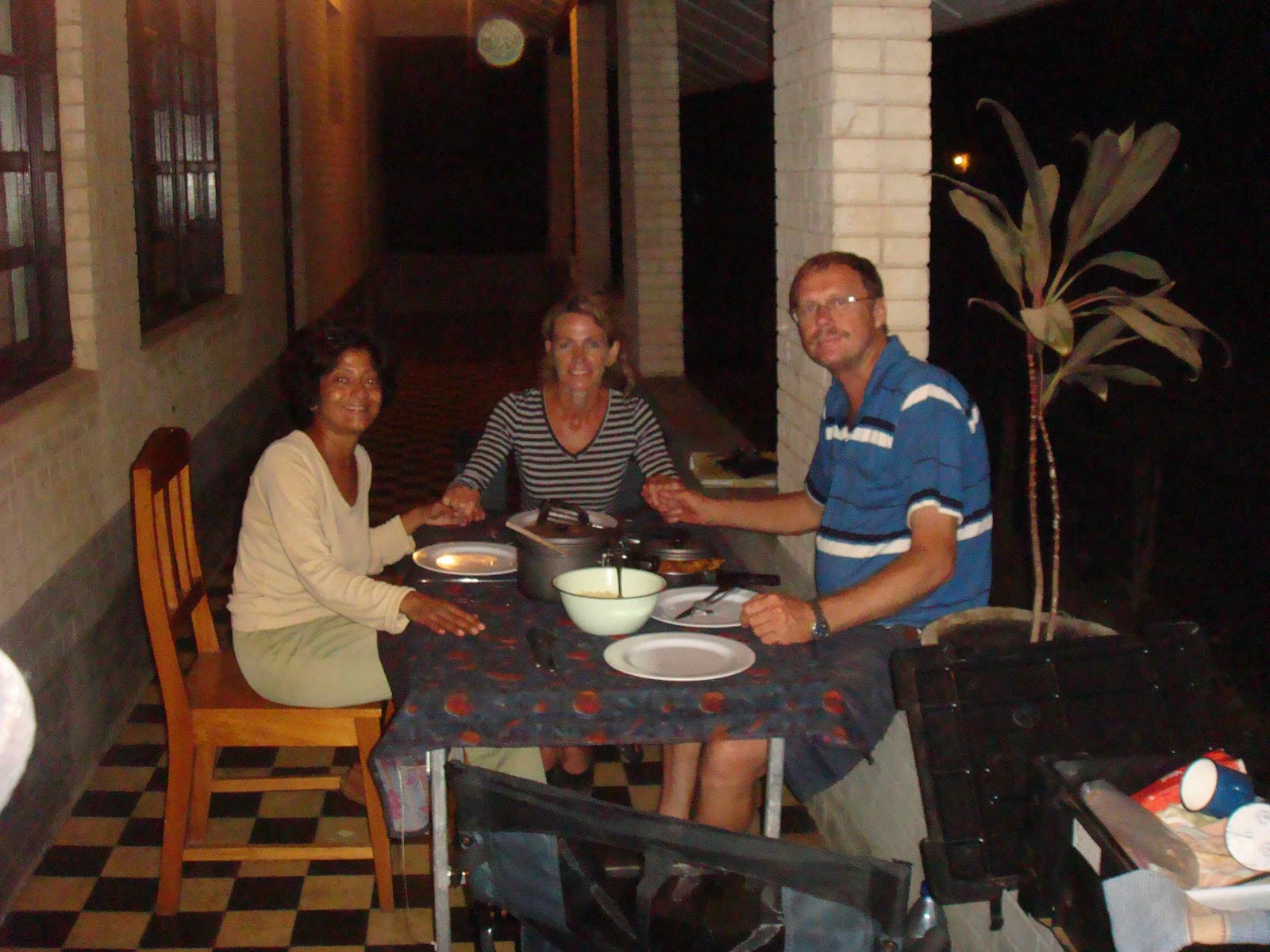
She made curried spinach chicken with rice and Mariana made some sweet potatoes. They were nicely settled to eat when the padre came back. He was very welcoming and spoke fluent English. He let them finish their dinner and then came back to speak to them. He seemed a well traveled person who understands about people who are on the road.

The living quarters he offered them was a bit neglected but then the whole place was like a building site. The church was building a school there and they were working on the whole plot at the time. She cleaned up a bit and they settled in for the night after washing up.

Road Nzeto-Ambriz
They all slept well, it was dark, silent, cool and peaceful. There were not mosquitoes either. After a short chat to the father, coffee and some basic repairs on the car’s radiator the next morning, they were off. The road was good, winding a bit up and down but good. The Chinese were working on this bit. They reached Nzeto in good time and went into town after the police at the road block said they had to register in town.

Example of baobab on the coast road
In 2008 they had a puncture there. They found that there was more going in the town than back then. There were many new buildings and people coming and going. They also found the graceful old house that was abandoned. It looks over a nice, calm bay where not much is going on.

Part of old fort in Ambriz


The police was more interested to show them where to buy fuel, bread and draw money than get them registered. And they proceeded to Ambriz. Here the road gets interesting to really bad. It was sandy with bits of tar. It had deteriorated about 100% in 4 years. They laboured through slowly, looking at the somewhat magnificent baobabs in these parts, there were more of them than anywhere else on their trip.

Broken clock tower
The bit of road getting into Ambriz was graded and they were still working on it. This is or was a graceful old place that has an air of ‘faire bon de vivre’. It was a bit empty of life in the main roads but they did see a brand new compound on the edge of the sea.

Back of lodgings in Ambriz


They found the one hotel of the place – Hotel Ambriz and negotiated for a room and for the Malherbes to sleep in their car in the parking at the back of the hotel. With a bit of upkeep this place could still be a nice place to stay when visiting this beach town.

With the new compound of some oil company and a few banks with ATM’s one sure gets the impression that there are great plans for it in the near future. Let us hope that they will not destroy the style and feel of the place.

They went to have a drink at the one café just a stone throw from the hotel. From the way it was set up, it looks as if this was the sports’ club of the town. On one side there was some sort of coat of arms with ‘flying club of Ambriz’ engraved in it. On the main road there was also the ruin of a building, it has a broken clock tower.

Sunset Ambriz
They prepared their own dinner under the ‘paillotte’ of the hotel – mince, vegetables and pasta followed by stewed fruits. The room was somewhat warm without the fan but they managed to make a good night. They were woken by a truck starting up in the parking of the hotel.

From there, they headed south by the coast track. This was pretty smooth in most parts. However, they missed a turning and wandered through some really poor villages where a motor cyclist offered to lead them to the main road – it was tarred he assured them. Well, not quite. It was the continuation of the disaster that leaved Nzeto: part tar, part sand, not graded and getting worse for wear.

They got to Barra do Dande just after 13h00 and opted to find some place to eat before they decided what to do for sleeping. They were seated at this nice restaurant by the sea when they heard the people at the next table speaking Afrikaans. They struck a conversation with them, asking about the area and what is to be done and seen there.

Lunch at Prada Garda
Soon after these people were offering them a place to camp at their place of work. It was very nice of them – the place had all manner of comforts: hot water shower, kitchen etc. They accepted and drove there after their delicious lunch of garlic prawns and chips.


Dinner with new acquaintances


They offered to cook harira for these people and finally they were 10 for dinner. It was very jolly. The harira was very filling and there was mixed fruit for pudding as well. The people enjoyed themselves too.

Fishing port Barra do Dande
The next morning, they all woke up later than usual. They had a nice breakfast in the kitchen and then prepared to move. They said their farewells and drove off to get some fuel further on the road. Koen and Véro were meeting them in Barra at a camping place about 5km out of the town.


Lunch in fishing village
They found the place but the guy at the entrance said they could not enter. When Koen and Véro got there, they managed to find out that the place was under renovation and was closed for the time being. So they went to the fishing port of Barra and chose an eatery at the sea front. There the ladies went to choose their fish and they all settled for a nice meal and drinks. It was an array of grilled fish with beans, plantain bananas and sweet potatoes.


Ambling into Angola


Finally they were through and drove a few metres forward to the Angolan border post. This place smells of unwashed toilets. There were not many vehicles but the people passing on foot were quite something to watch. There again the women sat in the heat of the cars and waited while the men ran from one office to the next: immigration, customs, health, fiscal control etc. At all those they were desperately slow.

It was a bit of a circus, especially because they were travelling with 2 passports each now. The one had to be stamped out of the Congo before it could be stamped into Angola and the immigration office would not hear of it. They were all behaving as if we were the only foreigners they have seen in ages.

After more than 3 hours at the border they started moving, then there was the one barrier and another but eventually they were on the road to Cabinda. There they were told that they had to register at the immigration in Cabinda as well, so they thought they’d find the catholic mission there and sleep there too.

Side road stop to fill radiator
They stopped to make sandwiches for the men who were hungry, thirsty and cranky as well. On the side of the road there came a drunkard who asked for cigarettes – she quickly sent him packing. And they ambled on south. The road was good. They passed a few small towns and the bigger and more picturesque town of Cacongo where they could have stayed at the catholic mission too.

It was getting to sunset when they reached Cabinda. Big town with fair roads, quite well organised but dirty in many places. Well, they found the mission in Cabinda, the padre was not in and no one else could give them the information. From there they moved to find hotels and finally opted for the rather expensive HD hotel that offered them safe parking for the cars.

The hotel was nice, clean and had hot water and a generator. Because as it invariably happens in these oil producing countries, the power went off some time after they checked in. They bought pizza and had that in the room. They both slept fitfully on these comfortable beds.

The next day they had a copious breakfast at the hotel. Then the men hopped into a taxi to the immigration office to ‘get registered’ and enquire about the procedures further. They also bought cell phone sim cards and went to the port to enquire about ferries to the other side.

It was all a rather so-so exercise since the immigration people did not quite know what to make of the passports, nor had they heard from their people at the Nzassi border and were not clued up about other accommodation. The ferry to Soyo only takes people, not vehicles and to get the vehicles to the other side would take the army plane that would cost a bomb.

So, they decided to check out of the hotel and proceed to the DRC border. The procedures on the Angolan side was done quite fast but when they reached the DRC side, the one immigration officer insisted that their visas were not valid because they did not get it in the country of residence. He would only sign them in if he receives orders from his Director General in Kinshasa.

Then began about a six hour wait while they bought a DRC sim card and tried phoning the SA Embassy to see what could be done. Finally one of the immigration people got some information for them and there was more phoning and more waiting. At around 16h30 the Congolese officials started closing the gates of the offices and they were still sitting on the benches inside – small blessing that there was a nice breeze there and the town did not smell!

A while later they were told to drive the cars through the boom and the men should go in to see the immigration officer. The passports were signed and the carnets were done; the sun was rapidly going down.

Dinner at the Mission
It was a sand road through some oil fields. It was graded but traveling was at a maximum of 60km/h. They opted to sleep in Muanda that night. They found the tar road into town and then someone pointed them in the direction of the Catholic Mission of Sacré Coeur. This place is at the end of a sand road on the right hand side, a bit before the tar reaches the beach.

Considering that this was the DRCongo and that the country had been through unrest and war, this mission was remarkably well kept. It was practically on the beach. As things go in the Congo, when they see Mundele prices go up. They negotiated for the Malherbes to sleep in their vehicle and they took a room – cold water shower only mind you!

That evening, the ladies cooked a copious dinner of fish cakes, mixed vegetables and mash. When the men finished ‘setting camp’ they sat for drinks and discussed the road ahead. Levels of stress were high after the drama at the border.

Road from Matadi to Songololo
After a nice cold water shower all retired for sleep with the sound of the waves crashing on shore. The mission gardener was the first to start his activities, which woke them up. They had their usual morning coffee with some cereals and canned fruits and were on the road.

Road side oil pump
USD20 toll road!!
The road out of town was sandy. It went through the other side of town where schools and houses were built within metres of oil pumps. There were quite a few of these pumps around the place. The road became a graded laterite one a bit further out of town. It was not good and they had to pay a toll fee of USD20 for that. Only in the DRC can they rip you off like that. 


This is a country that has gold, diamonds, uranium, oil and much more. The example is set right from the top, by their (mis)leader.

The Boma to Matadi road was not good, they had dug the bad tar and graded it and left the ok tar in – it was a constant hop onto tar and down onto laterite. And in parts it was just dodging and ducking.

Part of Matadi town
Matadi Port
But they made it to Matadi quite early enough to decide to move onto Songololo to see where they can sleep there. They had heard that border crossing at Matadi is hectic and not so pleasant. They decided to cross at Luvo.

Braai at Songololo
At Songololo Coen did not feel like sleeping in the car in front of the police station so they booked into the only guest house there – Guest House Km5. This is ‘establishment’ is managed by a rather slow-to-understand guy who spoke a bit of English. He was very helpful though.

Braai dinner at Songololo
He allowed the Malherbes to park there and they used one of the kiosks under construction as a kitchen, another as a shower and another as a dining room. The only disadvantage is that this place is rather close to the road and there is a constant movement of heavy vehicles.

Dinner that evening was the longed-for braai of excellent meat that Jimmy had given to Stephanus. The guy had bought some charcoal for them and he also offered his stove. 


While the men were grilling the meat and having refreshments, the girls made mash and mushroom sauce. They made a very copious and animated dinner. There is no power is that town, nor running water either. The guest house put their generator on at 18h00 and switched it off at 22h00.

With a good warm shower, they all retired to some kind of sleep or other. They put the fan on and closed the door and windows – there was loud music from some establishment not far off.

And they departed southwards to face the road, the border crossing and whatever else awaited them. On the Congo border, they had the cars’ papers stamped quickly enough but were told to wait a bit since the immigration guys down the road were not on duty yet. They waited an hour and were told they could proceed.

There, they found there were already quite a few people having their procedures under way. They had to queue up at one office to have their passports registered and then another officer took their passports and had to examine it. At this point another more senior officer popped up and said he would look after this.

When Coen asked if they could stamp both sets of passports – the one they were travelling on from the start and the one with the Angolan visa, the guy said he would do it for a fee. There was no getting away from it this time. The Angolans insist on it and it had to be done one way or another.

What he asked, they could not give since they did not have change, so they popped him a packet of cigarettes as well as some small change. He had to be satisfied with it.

Sunday, 16 October 2011

Getting out of Gabon


Road through concession
Logging on the way
After coffee and biscuits and a packing process we were back on that bad road to the main road south. They were exhausted just thinking about it. But we made it to the north gate of the Shell concession in good time and there we had to wait for the convenience of an escort car that arrived about an hour later. After passing out of the east gate and 


getting to the logging barrier at Mandji they decided to push to Mouila.

There they found Hotel du Lac Bleu that has recently had a bit of renovation because the president was visiting. They were lucky the visit was over the day before and there was a room free for them, the Malherbes could then camp in the parking for free.

The room was comfortable, quiet and had air con. They opted to dine at their restaurant after she negotiated the choice of meals. They had some refreshments at a bench next to a disused swimming pool and then had hot showers in the room before going for dinner. Coen spent some time in their wi-fi area getting updated on news and e-mail.

The men chose the buffet which was made up of local food and the girls had pasta. There they discussed the plan to go further the next day.

Wake up to coffee and biscuits and leave Mouila before 7h that morning. It was still cool and the sky overcast. Outside Mouila it became a dirt road in a reasonable condition for most part, a bit corrugated here and there. At Ndende they did the formalities of immigration and customs: forms to fill and stamps in the passports – the stamp had run out of ink!

On to Doussala and then the road got a bit worse and they got to 3 rusty drums across the road. A barefoot girl popped out of one of the wooden houses and came to move one of them – no questions asked. After that there was the very obvious red and white boom. The place smelled of garbage, there was garbage along the road where they had to stop to do the formalities.

This was in a hut where the immigration officer was sitting at his desk with the poster of a yacht on the wall. The customs’ guy was not there and had to be called – his motorbike seems to have run out of fuel because his children were playing with it.

Eventually the paperwork was done and they waved us through much to the indignation of the guys from a truck nearby – they had to unload the truck for inspection.

Slash and burn in the country side
The country side is very much the same as in Gabon but with more slash and burn, the villages are dirtier and poorer looking and less trees due to rather savage logging that takes place in this country. At one point they saw flames from some gas/oil operation somewhere in the mountains.

Bridge over
From there on the road gets very interesting. At first it was these big holes filled with muddy water, the Chinese were working with a grader so we must be thankful that the other holes were filled by the time our cars passed. After that it was laterite roads, which have not seen much maintenance for a bit. It had not rained for a while and dust had accumulated on much of the road – it felt like sand roads, the cars were digging as they passed, it was very difficult to keep a steady course and make good speed.

Tea break by roadside
There were a few roadblocks and at Kibangou we were stopped and the men had to get out of the car and go present the passports for the guy to fill the details in his book. He said that after Mila Mila the road gets better. Hmmm, more kilometres of bad road and then Mila Mila and then it gets better but not for long. Quite a stretch before the N1, it gets laborious again.

And then came the round about where the N3 (where they were) and the N1 meet. This is a nice and new piece, complete with roundabout. They chose to sleep in Dolisie that night, so they went into town. There they started looking for the hotel that appeared on the GPS. Not very satisfactory, and they moved on to fill the car at the Total when she saw a catholic mission on the other side of the road.

She went to enquire and they did have a room and they said the others could camp for free. They inspected the place and called in the men with the cars. They parked and move some of their things to the room. She was cooking that evening: involtini with corned beef.

Coen and Stephanus were so tired that they just wanted to sit and have some refreshments and do nothing. The girls were getting the dinner sorted. They had set up the tables in a part of the garage that was free for them to use.

There was a cold water shower in their room. They all showered there and set up for bed. The mattress was a bit thin and the bed creaked at every toss and turn. But then things went quiet and they managed some sleep. That night it poured quite a bit. When they started packing in the morning, it was still dripping a bit.

She chose to drive to Pointe Noire. This is a new road, a few deviations around the bridges and some road works and land slides but otherwise great surface. It goes up into the Mayombe and down again to the coast, thus it is a winding road and they could not do too much speed on this one either.

Road works in the mountains
The scenery was interesting. The Chinese have cut through the mountains to make the roads. They were still clearing some places of the trees there. Logging trucks were seen on that road that morning. At the rate this is going, they thought they have to absorb as much of these views as possible because it will change drastically in the next few years.

Driving through market
It was Sunday and Pointe Noire was a hive of activity. They took the difficult road into town, they only wanted to fill the cars, get some supplies and head for the border the same day. But they found themselves in a very busy market suburb and finally, with the help of a policeman walking in front of the cars and her hooting at every turn, they managed to get onto a main road into town. The town roads are not very good – some potholes and broken in parts.

There, they filled the cars and got some supplies and headed out of town. The road further south is good and they made it to the border it was after noon. The procedure on the Congo side was quite simple but not quick. There she sat in the heat of the car and watched the comings and goings. The customs officer at the border was quite good at giving people a hard time and then he collects something out of the barrow of some vendor passing through. Then comes the handicapped on their wheelchairs full of provisions – there is an agreement that the handicapped can cross borders in these parts without paying taxes.

Monday, 10 October 2011

Onto Omboué

She boiled some eggs, made coffee and they were on the road further south. The decision was to keep to the plan of going to Omboué and to stay there 3 nights. They thought they had enough fuel and could fill a Fougamou so that they could make the road back on one tank.

There was a hype in Fougamou, the President and his Ministers were visiting the area for a few days and Fougamou was the first stop. The road there was good and when they reached there, the town was teeming with military, there were people everywhere, loud music and banners and posters welcoming the president.

And there was no fuel to be found in the town. The one petrol station was waiting for delivery. They still had some in the Jerri cans on the car but it was not a good situation. At Yombi, they turned off the tar road onto a laterite road. It was all right until they got to Mandji where they realised that the road had been done because the President was visiting there that day also.
Every shop was closed, they could not find fuel nor airtime. They were told that the ‘barrage’ was closed that they would have to wait about 4 hours in town, until the President leaves, to be able to proceed. It was sounding rather desperate and they decided that they would go to the barrage anyway and see if they can talk their way through.

Cutting of trees to clear land
When they reached there they saw a guy patiently taking their car numbers in a note book and then came to ask where they were heading. He nodded and then just opened the boom; and they drove through. From there the road was rather corrugated. It was not a nice drive. The scenery was fine, with open spaces in the forest where there was grass growing like lawn and mushroom shaped termite hills.
Road in forest
They had to ask their way around. At a place named Carrefour Rabi they headed to the right, but it was in fact the left that led to the place they needed to go to. They got to Yeno and were told that the road ends in that village. They got some fuel at some extortionist prices there and turned around.

The direction was Rabi Adax and when they got to that boom the security told them that Shell was the other gate. Barely 50m later there was the other gate with two uniformed security guys who took their letter of authorisation, asked a few question and then went to communicate by walkie talkie before saying that they could pass.
The condition was that the hazard lights should be on and they should keep a speed of 40km/h until they met with some rather surly guards in a pick up truck, who escorted them to the north gate. There they dropped off the letter of authorisation and proceeded on their own. The road got from bad to worse with big mud holes, they were considerably slowed down.

We stopped to refuel from the jerricans and carried on. They followed their instincts of the more used road because after a while signs became non-existent. It was getting dark when we passed some rather organised gas pipelines and met up with some Frenchman who was checking on his pipes. He said we were on the right road.

They carried on until she found some cell phone network and phoned Fransel at the hotel. She was getting worried and said she will come meet us on the road. Indeed a few minutes later she caught up with us. We followed their vehicle to the hotel.

Old rig equipment in front of hotel
Jetty and restaurant of hotel
There they checked into the rooms and went to have this dinner of fresh water fish steamed to perfection, served with mixed vegetables, rice, bananas and steamed cassava. They spent a silent and peaceful night. It was a bit warm but at least they managed to rest.
Fish eating croc
Trip on La Mpivié
They decided to stay 2 more nights and after a discussion with Fransel about what there was to do in these parts they had a boat prepared for them to go into Fernan Vaz, La Mpivié area to be exact and see the fish eating crocodiles that occur in these parts.

St Anne's Mission
Dried fish operation
The sun was timidly out, and with an 80 hp engine they got to the place in about 30 minutes. On the way they passed the famous St Anne’s Mission where there is an old church of red bricks. And they also passed an operation where they were salting and drying fish.


Spot the croc!


The boatman was good, he spotted the first crocodile a bit before entering the actual lagoon and it was there, on a branch with the mouth open. After that they saw quite a few of varying sizes. They also saw big fisher birds and some kind of swimming squirrel or otter.

They spent some time taking pictures and spotting other crocodiles before heading back on choppy waters; it felt like driving over these corrugated roads.

Camp at hotel Olako
They set up camp when they got back. She and Mariana got into the kitchen and started dinner with whatever means they had. It was quite a well fitted kitchen except for the lack of gas and a kettle.

Dinner was meat balls with sweet potatoes and mash followed by fruits. They set the table out on the veranda overlooking the lagoon. It was quiet except for the night insects. As they washed and settled for the night, the night watchman came in. he did finally understand that they did not want too many lights burning when they turn in.

Beach visit

The point of interest the next day was the beach. Some 25km out of Omboué is this beach of white sand. They checked in with Fransel for directions. But there was more to be done there, papers to prepare for the continuation of the trip, fuel to be purchased and so on.

Beach and lagoon
Beach
Finally all this was done and Fransel was very kind to direct them to the beach. Back onto the laterite road and then onto a soft white sandy track through a little wood. It was at what used to be a tented camp – now abandoned. They were the only ones there, white beaches with the sea crashing in. It was great to find such a place on earth. Yes the sea did bring in the plastics and logs but it was miles of nothing and no one.

Picnic at beach
There are traces of turtles and maybe hippos. They saw one turtle bobbing its head out of water in front of them while they were having a picnic. The picnic was made of the evening’s left overs jazzed up with what they had in the car: smoked salmon paté, hard boiled egg, avo, mayonnaise, tomato etc.

After some tea, they sat reading, writing or turtle watching while Stephanus had a nap.

Last dinner at Olako
They were back at the lodge where they did some organising of the cars and the camp while she organised for the people to prepare some dinner for that evening: deboned chicken the dish was called. After a good shower and some drinks on the veranda they headed for the restaurant. The food was enough and very tasty.

Sunday, 9 October 2011

Heading South


Equator

The morning was a flurry of activity to pack and get started. Jimmy was guiding us out of town. Coen was driving. Outer city roads are not good and then it got better as we approached the equator (again). There they did find the board announcing the equator a bit beyond the 0’00 coordinate where they stopped to have something to eat. But there came some rather annoying people – beggars more like – from the village and they soon packed up and left.

On the road they met with a contingent of the French army in Gabon most probably on their way to some place where they will do some exercises or something; there were quite a few of them trucks, personnel carriers, armoured cars etc.

The scenery was very much the same as the north, villages made up of cement houses but also wooden houses, people selling bananas and bush meat along the road, people carrying cut wood, slash and burn parts of the forest etc.

All countries have their natural beauty one way or another. Gabon has rain forests, rivers with white sand, sandy beaches and rocky beaches too. It is a warm place but all this would make for a beautiful country but for its people.

In all this nature, there is practically nothing left, they have eaten it all. Pretty fleeting statement but what can you think when you drive along their roads you see posters about protecting the environment: the trees, the turtles and the rest. Then all along the same road you see animals hanging, for sale: pangolins, mongoose, monkeys, snakes etc. You see posters about the training of game rangers but there are organised poachers in the parks.

This place is where rare species occur: leatherback turtles, dugongs etc. Let us not mention the logging that is taking place. It seemed to be pretty well organised in places but then you see parts of a forest just being burnt and the trunks cut in small pieces. Not forgetting the water and power cuts in this oil producing country where all infrastructure is not catching up with whatever development that is allowed to happen.

It is very unfortunate that there seem to be a handful of educated people here and then the rest of the population who does not seem to do much in general or to want to do much. Then there is a rather high population of immigrants who work – at anything: small vendors, house personnel, shops, and manual work of any kind.

Oil producing! And how come other countries are funding their forest projects, their roads, their food security programme?

And they went on south and further until she noticed that suddenly the temperature of the car had risen too high. This was in Lambarene where they stopped at a petrol station to fill. They pulled up into some empty area at that same petrol station and did a réparation de fortune with two part putty, waited for it to set and moved on.

Water source
They were told of a fresh, drinking water source further and they stopped there too. This is just a little stream jutting out of the flank of the escarpment; the water was clear and not as cool as she expected. The putty work seems to be holding.

Towing
However, when they wanted to start off, Hans’ car was not starting properly, the clutch was playing up. It would not make it to the next town, they concluded. They phoned around and Willem recommended that they go back to Lambarene and see with someone there if something cannot be done.

They got the towing gear in place and turned round in the direction of Lambarene. The road was good and it was raining a bit. At one point they saw a commotion, it was a truck that had recently driven off the road – lost control or something. They drove on and got to the airport to find the person who could assist with making a diagnostic on the car.

A few minutes later they were guiding the towing into the premises of the airport and very soon there were about 3 army guys onto the car. While they were finding out what was wrong, she drove out to find a place to sleep. She read about this ‘Soeurs de l’Immaculé’ and Coen found the directions from the army people.

When they arrived there, it was still raining but the sister said she can help them with rooms for a night or two but after that she was fully booked. The rooms were suitable, not cheap but as Gabon goes, it works out. They have the use of the kitchen complete with cooker, washbasins outside and dishcloths as well.


It looked like nerves were running rather raw when they were all at the mission. She opted to cook that evening and made couscous with merguez. They ate in the refectory reserved for visitors.

Lodgings above the nursery school at the Sisters of Immaculé
And then they prepared for the night, the water did not heat up in the shower but it was ok. The place was silent except for the odd car that raced down the road. It was a very peaceful night. They woke up with the noise of the army vehicle leaving the premises (the one guy on this army exercise sleeps at this mission every night).

Soon coffee was ready, the cars were hooked together and they were off, leaving Mariana with her at the mission. They went to the room where they watched school children coming in that morning – small ones on the sisters’ side and bigger ones on the other side. Very well behaved children altogether, prayers and singing of national anthem before going into class.

Entrance of the A. S Museum
Inside the museum
Old hospital refurbished
Later, when it was time to remove the car from school premises, they drove off to take a look at the Albert Schweitzer hospital and museum. This is on a scenic part of the river and they spent a bit more than an hour there walking and looking at the scenery and taking pictures. The girl who looks after the place took their entrance money and then said she had to go to the bank and will not open the other part of the museum! That is where they still have the original equipment that Albert Schweitzer brought in the first hospital.

After that they went to the market where they found and bought plastic kettles!!?! It was drizzling a bit but nothing nasty. The market was a bit of a covered place. People were friendly and explained a few things to them as they walked along. A short visit to the supermarket, and they were back at the mission to make tinned salmon sandwiches in the room. The kiddies had invaded the refectory by then.

The men phoned to say they were all right and making progress on the road. And they phoned again when they were leaving Libreville.

Land Cruiser parked at the church
Later they went for a walk to buy airtime and to check on the car. It was still very hot and they both went for cold showers afterwards. They walked off to the church where the car was parked for the day, when it was time to get it back to the Mission. In the meantime the men were back, exhausted and sweaty and also rather concerned about how Hans and Elismé were doing back there in Libreville.

Soon there were sms’ from them and the situation was discussed while they were having dinner at the Groupe DTH Traiteur that the sister recommended earlier. They ate copiously, the service was good too.

Friday, 7 October 2011

Lingering in Libreville


Jimmy was there to meet them and guide them in to his place. This is Mariana’s cousin who lives and works here. Even in this traffic, the police stopped them to ask for papers etc. but they made it to the apartment and were soon relaxing and Jimmy was getting lunch going.

He arranged for some of them to stay with him and one couple with his Dutch friends who live not far away. The men changed into town clothes and went to do the visa enquiries, dentist appointments and new glasses for driving.

When they got back, they started preparations for a braai that Jimmy organised that evening. The place was full of activities: cooking, grilling, making salad etc.. It was a very lively gathering.

The next day was her birthday and they got dropped at the apartment where the ever patient Jimmy was taking them on their rounds. Hans to the dentist, Coen to the optician and then the SA embassy again, and then move on.

The dentist was quick and efficient and he also spoke some English that Hans understood perfectly what he was doing. The optician was a bit more ‘folklorique’, a constant commentary on behalf of the man himself – comments about just anything and everything going on. And the glasses were ready, they did not have to leave a deposit or anything and he made them anyway. Coen was satisfied.

The embassy did not have much news for them at that stage, so they went to buy a pie for a snack while waiting for Jimmy. After that they moved into an area where they found all the embassies they were looking for to ask for visa forms and other information. In less than 20 minutes all this was done and they were on their way back to the apartment. They had a few requirements to get at the shops but it was between 12 and 15h and all the shops close for siesta in this place.

Birthday picture
Later, under the rain Jimmy took them to a little supermarket not far from his place. They got the requirements for that evening’s dinner. Back at the apartment, the prawns had to be cleaned, fish cut and Elismé was assembling the various paella ingredients. Finally, Marjolaine and Willem arrived and the assembly was complete for dinner.

It was excellent. There were prawns in there from Benin and Gabon, the rice was from the Songhai centre in Porto Novo, the lobsters were from the Gold coast and the soles from Accra. This hearty meal was followed by a ‘death by chocolate’ type of pudding and then every one, fat and happy, retired to their various beds.

Brake repair at Jimmy's apartment
While the men were sorting car issues and documents the next day, Marjolaine took them on the commercial rounds of Libreville. She was cooking dinner that evening and was getting the supplies needed for the event too. They also stopped at a nice café to have some real coffee and carried on with the purchases under a steady rain.

By noon, they were done and drove home to have a bit of lunch and a rest before starting the food. In the meantime papers were being done at great expense and time in town. In Gabon, if you do not have your passport on you at all times you need a certified copy of it at least and that has to be signed by the local police!

Dinner at Willem & Marjolaine
Dinner preparation was coconut chicken and she did that while Marjolaine went to walk her dog. Pitta bread served as rotis that evening and pudding was pancakes with ice cream and chocolate sauce.

This was hosted by Marjolaine and Willem and when the others arrived they discussed the cars and the places worth a visit in Gabon and they got to the table. It was a very animated dinner.

The men were again going out with Jimmy on the embassy rounds. The RoC visa seems to be rather straightforward but expensive and they needed guarantees for Angola. It was not reassuring not to know what was going on and what to expect but one has to be satisfied with what one got in these parts. The SA embassy was already finding some answers for the group and the rest they had to do.

Meanwhile, Marjolaine took them to Petit Paris, a place not far from the market where there are shops of all kinds. It was mainly fabric hunting there. It was not crowded but traffic was not flowing and it was getting a bit hot, in the end they parked in front of a bank and walked the rest of the way.

There were truly nice things in way of 100% cotton fabrics. They bargained, discussed, looked and enjoyed the whole process. After that they went to a bit of a more upmarket shop, the one that sells fabrics from the very advertised dutch company Vlisco. It was fascinating, there were other fabrics there too and everything was tempting.

After a brief visit to the supermarket, they got to the apartment where they prepared lunch and took a rest while waiting for the men to get back from their errands.

Coen got back exhausted but luckily they had eaten something on the way and were not weak with hunger as well. He went for a nap while she went with Jimmy to his office to do some blogging.

At dinner they discussed the proposed visit to some park south of the country, Omboué, where an authorisation from the Shell company was needed for access.

There was still a letter of authorisation for the car that had to be fetched at the RoC embassy and Coen still had to do the rear brakes on the car. Jimmy took her to the embassy for the letter, which was ready while Coen worked on the car.

Sunset at beach
They spent the afternoon resting and reading until it was time to leave to watch the sunset at a hotel in the suburb of Sabliere. They were lucky, as they got closer to the place the sun peeked out from behind the clouds. There has barely been any sun all these days they were in Gabon – rainy season has started.

It is a fairly clean beach where loads of tree trunks have beached (from the logging activities) and serve as wave breakers.

Soon, they were joined by two other couples and it was 11 people for dinner at the Sunset Hotel. She had grilled fish, Coen had lamb chops and the others an assortment of brochettes, pizza, salad etc. This was also a very animated affair.

New Stadium
The following day was an outing to Cap Estérias and Cap des Pères. They had breakfast with Willem and Marjolaine and then went to meet the others for the outing. They passed by the newly built stadium – built by the Chinese and supposed to be finished for the CAN, which starts in January 2012.

Forest project just out of town
It is all more or less a stone throw from Libreville but the state of the road being what it is makes for a rather bumpy ride most of the way. On the way they stopped and walked a little in a forest project. The original idea was a good one but that slowly went into neglect. Now they mention the various circuits one can do in the forest but they are not marked and getting lost is a risk.

Cap des Pères
Cap Estérias
Cap Estérias is a small coastal town with a lighthouse. The beach is also littered with tree trunks and other thrash that the sea brings in. It was very calm when they were there and the sea was cleaner than she was told it is. They took pictures and walked on the rocks for a bit and then went on to Cap des Pères.

The place seems to be ‘owned’ by the military that have access to the nice beaches there. But they just pushed the boom open and drove up to the one kiosk where they had some drinks and chips while taking in the view.

They shopped for the road and had dinner of seafood bisque and pancakes. They all shacked up at Jimmy’s that night.