Wednesday, 14 September 2011

Heading north …… and out to Togo... and Benin


When they reached the Tema roundabout, they thought they followed Hans’ directions to find out that they were on a road parallel to the coast instead of heading north – there are but few and rather hidden sign boards on the Ghanaian roads. They stopped to ask a policeman who said they should go back to the round about but to ask at another police barrier. Before he let them go, he asked for ‘chop’ money, just like that, straightforward because, he said he was protecting them against gangsters.

And we went back, asked another nice traffic police who even drew a map for them and asked for nothing, just wishing them a good journey. The road north toward the Volta river and the lake is quite good, tarred with few potholes but quite a bit of traffic.

Bridge over Volta river
On this part of the Ghanaian roads at least the speed limits were better indicated even if the directions are not. So, it was 50km/h in town and 80 elsewhere. There were a few road and customs’ blocks but they were more interested in trucks and goods vehicles. At the busy town where THE BRIDGE is they stopped to ask for better directions, take pictures of this rather scenic bridge and make a good sandwich for lunch.

Bush taxi
On we went and the road got a bit more broken. However, in this region you can see a difference in the way people live – it was not one on top of the other like at the coast, they have space between the houses and huts, these small towns are quite clean and it does not have the feel of a perpetual market day like in the rest of the coastal towns we have travelled. 

We were heading to the Mountain Paradise lodge where the rest of the group was camping. Coen was following Hans’ directions but was getting a bit concerned that they might have missed the turn off. She was driving and stopped a couple of times to check the ‘kente’ work that she could see from the road. At one place, they were weaving but the one youngster said they could not take pictures. Walking among them, she realized that these weavers were not much older than children, teenagers actually.
Scenery over mountains
There were huge billboards on the Ghanaian roads about human trafficking and child labour. She thought that it was not common practice because there was a law and some kind of authority watching. Somehow, one has to know where the ‘kente’ cloths come from before buying…..

Mountain Paradise
Hans phoned as they were turning off into the road leading to Mountain Paradise. He warned them about the wet roads and Coen engaged the hubcaps. She made the ascent with little enough difficulty while Coen was constantly dishing advice.

Mountain Paradise
This is also a beautiful and serene place. There is no saying what this place was before the owner, Tony, took it over – he is rather hazy about it all. But it has a churchy feeling to it. Coen was too tired to pitch a tent and they took a room that came with shower and toilet. It was basic, with netting in the windows and a fan but the shower is cold.

Elismé said she was making dinner that evening. The dongle was working and Coen was checking mail and getting other information. Dinner was early, they sat up to do some more internetting in the room too. That night it rained hard and was she happy she was in a room instead of the tent.

Petrol station from last century
In the morning, Coen had a little breakfast, they paid their dues and Tony took them to the border post. He was acting as the facilitator and charged Cd20/car. Then there was the immigration guy to pay to take them through the procedures. It was a small enough border and it would have been no hassles for them to have done it on their own. However, it was not easy to find.

The plan was to reach Notse that day and then proceed to Benin the next day. The dirt road between the countries is not good, it got better in Kpalime but then the road crossing over to Notse is bad.

Ant hill in the fields
Roadside cemetery
Village of Togo
And they trundled on slowly. On the way there were cassava, yam, peanut and other plantations. Lots of mud huts with straw roofs are also seen on that road. However, in the cemeteries there are some rather fantastic tombs. Here also, religion is ‘big’, there are churches, mission schools and missions in all these little towns and villages and bigger ones in bigger towns.
Wood for market

Women going to market
When they reached Notse, they asked the way to the gendarmerie to enquire for a place to camp. They went to Haho hotel but no decent camping was possible and then they were directed, by the local gendarme, to Le Berceau. This is a biggish hotel just outside town, on the south road. 


Down into Togo
They have a big garden, swimming pool and all. They agreed, if they take one room, the rest of the group could camp for free. They did not have any conferences or weddings going on and there were practically no clients at the hotel at the time.

Coen saw the storm brewing in the distance and preferred to take a room in case it came our way. The others went to settle in the garden not far from what is the nightclub of the hotel. It is a surprisingly well-kept place for such a town as Notse and the prices of the rooms vary. It was not excessive to take a room in their old wing; Coen wanted a warm water shower.

The next morning, the others were waiting for the forex bureau to open before we could move. When he finished breakfast, Coen had enough time to clean the spark plugs and then we drove off in search of bread for the road and other ingredients worth consuming. The road to the border from Notse is a dirt road, not well kept. So the progress was slow.

The border post was practically empty but the officials took ages to fill the forms themselves and check and counter check. The customs was easier, the guy had to sign the carnets and affix his stamp. On the Benin side the procedures were slow too and at the customs they had to pay more because it was a Saturday. They did get a receipt that showed the details of the payment though.

Further west... and east

The road was good, in general. One had to look out for the occasional potholes, try to avoid getting stopped for speeding or any other reason and see the tollgates – it was 1Cedis for 4 x 4’s. They drove through palm plantations and following directions they had to go through far ranging rubber plantations to get to Kedra’s lodge.
This was down a sand road, through the rubber plantation, through a small village, in its own little bay. A well-appointed lodge with a dive centre. Unfortunately, the weather was too unpredictable, the sea was still murky and diving was not possible. So, they went on to the next bay and stayed at Ankobra lodge for a night.
Where Stumble Inn was airy and gave an impression of space, Ankobra, in this gloomy weather, seemed dark. It is set up in the midst of a lot of palm trees. It was well kept, they try to grow as much of their own food as possible and they have budget rooms available in the staff’s village. That evening she had fish soup and Coen had grilled chicken with fried rice. The chicken was grilled just right.
They decided to get as close to Accra as possible so they could get to the city easily. And they set off to Kokrobite the next day. It was a long road. Not exactly in the distance but because of all the towns and villages on the way, the speed bumps, the traffic and the roadblocks.
Beach chez Milly's
Well water for shower
They asked their way a few times and finally saw the signs to the town. That was also through a corrugated dirt road. It had a few speed bumps too. They were aiming for Big Milly’s backyard. This place has a backpackers’ camp atmosphere to it. They found a place for the tent and pitched it there.  The toilet had to be ‘backet flash’ (as it was written on the walls) and it was also a bucket shower after you pulled the fresh (cold) water from the well. 
They went to the kitchen and ordered dinner and settled to enjoy that on a small, elevated terrace overlooking the sea. The food was nice: barracuda fish fingers with chips and chicken curry with rice. Had a cold bucket shower and went to bed. In the morning they were awakened by the one caretaker brooming the area where they pitched the tent.
Eventually they woke up and had the usual coffee and biscuits. They asked for directions and information about getting into town to search for parts and started off just before 10. The traffic flowed and stopped and flowed and they got to the famous Abossey Okai market and found a ‘garage’ where someone was keen to help look.
After long discussions, Coen realized the guys did not quite get what he was looking for and another discussion ensued. Coen and the one guy went searching while she was offered a comfortable chair in front of this ‘garage’. After a while he came back saying that this was not available here.
Then we tried to head to the ‘mall’ where Coen thought he could get a fast enough wi-fi access to do his mailing but the traffic was nuts and they turned back and headed for the Art Center. The road they took was disconcertingly free at first and then the chaos showed up. When they indicated to turn and turned a policeman stopped them saying that they were obstructing traffic and liable to cause an accident. He wanted the driver’s licence and then wanted to come with us to the police station.
He must have realized that there was no space for him. She asked him pointedly where the police station was and after the second time, he said they could go. It was the right road to take and soon they were at the Art Center and even parked inside. Coen opted to sit at a small café and have a cool drink while she scouted the shops.
Kokrobite pizza
She tried to do some quick thinking and shopping because they did not want to take the road at peak hour. Unfortunately peak hour caught up with us on the road and it was very slow to get back to Kokrobite. Once there, they had a quick bucket shower from well water and walked up to Kokrobite Garden which advertised pizza. They had some bruschetta and pizza that were very tasty.
This place is run by a Spanish/Italian couple. He cooks and she manages. They also offer accommodation but not much by way of camping. The lady of the place said that she met her husband when she visited the place years ago and stayed because of his cooking.
There was loud music from somewhere on the beach for quite a while after they got back to camp but when it stopped, they spent a good night. Their next day was spent in maintenance and cleaning of the car. That done, Coen got cleaned up a bit and they had a bite before doing some footing into the village in search of an internet ‘café’. There are no indications and after asking a few times, they were pointed to the upper floor of the ‘tall’ building (one storey high).
Sabina at Milly's
After a walk on the beach they shared sundowners with the German lady (Sabina) and then they went for dinner at Milly’s kitchen. It is pleasant up there overlooking the sea. That evening her twisted ankle was hurting and they bandaged it after an arnica treatment.
The previous afternoon a couple drove in in a Land Cruiser that most obviously does long distance runs and when they struck a conversation with the guy, it turned out that he knew who could fix the car the way Coen wants. After a few phone calls, the person in question pitched earlier than the agreed time next morning and Coen left with him and the car to see what can be done in order to be safer after the very approximate work done by Mackno of Centurion.
Updating at bar!
They did what they could with the car while she sat at the camp and tried to update the blog. There she met with the various inhabitants and visitors of the place, they all stopped by to chat and exchange views. She had a quick snack of bruschettas for lunch and after that spent most of the afternoon sitting and discussing Africa with Godfrey and an American lady visiting Ghana. The dongle was working but not strong enough for uploading pictures.
The car, Coen and Kudjo the mechanic got back to camp earlier than we expected. Tired but the work was done: they added springs on the car. We could leave the next day. That evening they went back to Kokrobite Garden to sample some more of their food.
There was a short power cut at the camp when they got back, it was nice, silent and dark for a bit. Then there was some frantic action when the power came back but one part of the camp did not light up. They had a good night and woke up when the leaf sweeper started his work at 6h00.
filling car before taking the road east
While packing a few people came out to say goodbye and to help out too. They first stopped at the Shoprite of the area and did some shopping for the road, then struggled a bit in the traffic and got to a spare part place Coen visited the day before to get addition ‘bumpy rubbers’ for the car and we went on to join what is referred to as the outer ring road. To get there we were stuck in quite typical Accra traffic and when they did get onto the road in was under repairs, the one side was completely dug up and the other side has become single lane in both directions. The people of the road construction were directing the traffic a bit more efficiently than the local police!

Monday, 12 September 2011

On the go in Ghana


Great dirt roads!
The border at Hamele was also not busy but everyone had to be present at immigration to fill the forms. The customs people did the Carnets and the health people insisted on seeing the vaccination cards. But it was all done within less than an hour and they were off south on a very bad dirt road that would last for the rest of the day and part of the next day.

Camp food
It was getting late and the final decision was to bush-camp. They guys went to ask a village chief for a place to stay and they were shown an old quarry. It had rained here too and there were puddles just about everywhere. She was to prepare food that evening and she felt that making food has never been such an ordeal as in camp.

Lightning had started in the distance and they barely had time to get into the car before the rain came down. It was not a pleasant evening and she barely slept that night. The next morning was miserable when they prepared to leave. They wanted to thank the chief for his hospitality and went to see him but he was not there.

It was not until they reached Nadowle, a town just before Wa that the road was tarred and better. Until then it was a bad dirt road, tarred only in the towns and dirt again out of town. By then they had passed a few roadblocks, both customs and police. Here the police do not hesitate: at the first road block in Ghana they were asked for bread, when they said they did not even have the local money to buy bread, that they only had CFA’s they were told that the police would want to see the CFA. She dug out a few coins to show them.

At the second road-block where they were stopped, the one policeman asked if they were not ‘topping salary’, she understood immediately. But Coen did not quite catch and asked again and again, until the policemen just waved us on. A few days later they were stopped at another road-block. They thought they were flagged down because they were speeding but the guy’s ‘speed gun’ was switched off. At first he wanted some water and she agreed to share some of their water with him if he had a bottle.

Then he went on to give them a lecture about how it is illegal to drive a right hand drive vehicle in Ghana, that they needed a special permit to do so. Coen told him that they were on their way to Accra to get one. He was, by then, hanging on to the driver’s licence and kept on with that line. Then he downright asked if they could not give him some Cedis. There, Coen told him ‘then you will arrest me for bribery’ and was he flapping to explain that it was not that but a contribution. Nothing was given in the end and we slowly edged out of the situation.

In Morocco it was café’s and snacks (short for snack bar – even if they did not serve food there!) in every corner; in Mauritania these were rather scarce. In Senegal you do find restaurants and patisseries in many parts of Dakar, less in the countryside. In Mali there are restaurants, patisseries, boulangeries, bars and cafés but in Burkina Faso you start seeing more ‘maquis’ which seem to serve the same purpose. And as you drive into Ghana you see ‘drinking spots’.

As many writers before me have written, they are big on religion in Ghana – their own version and interpretation of it most likely. There are churches and seminaries all over the place, mosques are more frequent in the north but they are all over the country too. In the most decrepit place, if you find a good, well painted building, it is highly likely a church. In the cities they take some rather gigantic proportions. And then you see God’s Help Drinking Spot or The Will of God Drinking Spot and they use God’s name and Jesus’ as well to name their business. We even passed a building called ‘Anointed House’! Go figure how this country is in the state it is these days.

Market traffic
And so, they travelled on to Kumasi. The road was good in most parts, with some big potholes from place to place and 50km/hour limits in the towns along the main roads – and there are many of those. The decision was to spend the night in the Presbyterian Guest House and proceed from there. It was raining when they got to the edge of the town.

Hans had put the coordinates on his GPS but that was playing up and the traffic was building up as they got into town. It was Eid in Ghana that day. The GPS gave them a run around and somehow Hans was resisting the idea of just asking a taxi to get us there. He then said all the cars should turn into one road up from the market street and then we fell in the midst of the Eid festival. There were thousands of people in that road, very loud music and a major traffic jam.

Finally, he got someone to clear the road in front of the cars and guide us. This person did not speak a word of English and eventually they had to stop by the Catholic church and ask a muslim passer-by to explain to him where we wanted to go. When we got to the Presbyterian church it started raining. It was downright pouring when we entered the premises of the guesthouse. 

Luckily the security was able to dispense rooms. They took a room, she found something for Coen to eat, they showered and went to bed. It was a pleasant enough room with a fan but there were mosquitoes too.

It was still overcast the next day and they decided to head for the coast. The others were heading to Accra because Hans wanted to have his car serviced. They had breakfast at the guesthouse and got into conversation with a German lady who was there. They told her where they were heading. She was heading for the coast too.

Going for Gold ….. Coast.

They went to get connected at the MTN office on their way out of town, took a small road and finally reached the main road south. This was a tarred road, for a few kilometres, they were working on this road and travelling was a bit slow but after that only passing through towns was slow and they made it to Cape Coast at around 14h00.

Elmina 'Castle'
Cape Coast is a big town. It also has one of Ghana’s biggest universities on an immense campus. We went on with this road, due west to Elmina where they wanted to stay at Stumble Inn, a place they heard of. She was driving at this point. The road into Elmina town was narrow and full of people. The market was on full swing. The fishing boats were in the little ‘harbour’ there and it was quite a sight along with the ‘castle’ at the peak of the cape there.

Stumble Inn
Engaging onto a rather bad dirt road, they stumbled in. It was still cloudy and it had drizzled a few times on the way so they decided that they would not set up camp but rather take a room (no bungalows were available that day). This was a spacious affair with a large bed and a smaller one complete with mosquito net. Toilets and showers were in an outer building, clean and adequate. But since it was drizzling and there was quite a wind from the sea, everything had this ‘moite’ feeling to it – a dampness that was inherent to the place at that period.

Gold Coast
The Dutch couple who run the place are very nice and helpful people. They had started asking around if diving was possible in the area after Coen had told them that they were interested in diving. The wind was blowing a bit when they got there and the sea was rough. It calmed down a bit and later the breeze made for a comfortable evening. By then the German lady they met in Kumasi had joined them. Since many of the places along the road were either busy or beyond her budget, she thought she’d stumble in as well.

Lobster dinner
For dinner that first night they had freshly caught lobsters, grilled to perfection, served with rice and garlic butter. It was excellent. The lobsters were a bit small, the girl said, so she served some beef stew with yam chips as well. They made an excellent repast.

They found some books on a shelf there and spent much of their time reading. The next day, they decided to go into Cape Coast to draw some money and see about getting some parts for the car. They did an oil change at the Shell garage on the main road and then went to town.

Side road vendor selling reed rat
They call this town the old capital. The roads in the town are narrow and most of them have become one-way streets. Getting to an international bank was a bit of a mission and when they got there, there was a carnival going on. Again, lots of people, loud music and traffic jam. But she managed to draw some money. The teller was not giving more than 200 (about R1000).

They thought they could go to the teller on campus. That campus is a town in itself but road signs were scarce. After asking for directions a few times, they found the Barclays ATM’s that were not working that day!!

Tire repair
So they went back to the Inn, passing the street vendors and Elmina town. They stopped there to have a tire repaired. Where Q-tyre had left the valves in, the tube was thinning and losing air.

They spent a quiet afternoon reading and resting. That evening, they had a meal from this excellent kitchen again, with yam chips. The next morning, they had breakfast, packed the car and were on their way west to look for the diving place they were told about. 


Broaching Burkina Faso

Waterfall on the road down
The shorter road to Bankass is mainly a dirt road with cemented parts. It is all right as these roads go. For the first most scenic part there is no going fast since it is rather steep downhills after a bit of uphill. There you pass through these typical villages, rock formation, valleys and then plains. It was all nice and green at this period of the year.
Down from the Dogon plateau
Women at work
After Bankass we headed to Koro, the Mali border with Burkina Faso. From Bankass to Koro it was a dirt road that was being regraded, we had to proceed with caution since the work seemed to have just started and there were still some bad bits. Hans was not feeling well and Elismé was driving.

They stopped for a snack break and got stared at by some local children, and then carried on. The Mali border post was a shack in the middle of nowhere and there the officers found that they had overstayed their ‘visa’ by one day. They understood that they had a month from date of entry and the immigration officers insisted that it was as per the dates on the visas. So they had to pay to get out of that country.

It is not as if they want you to visit the place and stay longer, they penalize you for staying and spending money there. To crown it all, they do not really know how to read and write fluently at the border and took it for granted that the others had the same visa and wanted to make them pay as well. It took ages to make them see, read and understand that not all 6 visas were the same. In the meantime Hans sat there suffering in the car.

The Burkina immigration was also a bit in the middle of nowhere and the officials there were rather relaxed about things, waved them in the office, did the papers and visas there and then and waved them off. Customs was done 17 km later in a small town on this still not so good dirt road.

There, there was a lady customs officer who knew the procedures about the cars etc and soon they were on the roads. She had warned them that the road in was not good for at least 35km and then you reach the tar and it gets better. That was another hour or so of slow proceeding. By then Hans has had a few shivers, a few calm moments and a few headaches too.

The tar road to Ouagadougou was good, it had a few holes in the middle but in daytime it was all right. Then, just at one of the toll gates, Stephanus reported a flat tire. They soon found a bolt in that one tire. They replaced the tire and carried on when barely 10 minutes later, he reported another flat.

Coen turned back to assist and they asked Hans and Elismé to carry on to the city and find the place they agreed they will stay. It was getting late into the afternoon and they carried on. After the tire change Coen asked Stephanus to take the lead as his GPS  was showing the Ok Inn where they were stopping in town, and his lights were more efficient on the roads at sun down.

The road was busy, there are many villages along it. It is a nice road with trees on each side for most part but with bicycles and motorbikes without lights on it, it was a bit tricky to navigate. Following GPS indications, they got into the city, in the general direction of the inn. They kept calling Hans on the radio to see if they were around and when we heard them, we were all in the area where the inn was but could not find it.

She saw a sign to the inn as they were passing it on the highway and they had to turn back. They asked about a side road and were given some sort of directions but still could not find where exactly one had to turn. A guy on a motorbike told them that there were no roads where they were going. Instead of asking if they wanted the OK Inn, that he worked there etc, he kept saying that there was no road there.

In the end, they stopped and asked him what they were supposed to do. Then only he told them that he’d direct them there since he works there!

Hans had also asked someone from the streets to direct him there and had just about got into the parking when we arrived. It was late, they were tired and all opted to take rooms there. The place is old but the rooms are adequate and their kitchen serves excellent food. She had veal tongue with hot sauce that first night and Coen had Lemon chicken while Stephanus had steak with béarnaise sauce and Mariana chose spaghetti Bolognese. Elismé said it was too expensive for her to have a room and eat at the restaurant!

The priority of the next day was tire repair which Coen and Stephanus were to do together. The driver of the hotel showed them a good place where this can be done. When they left, it was agreed that Hans would go for tests at a reputable clinic.

Coen had 3 eggs for breakfast and felt he could tackle the day. But he did not reckon with the sloppy job done by Q-Tyre in Pretoria – they left valves inside tire. That meant that all the tires had to be checked. And they said that this place was in town and the traffic there was terrible.

At the clinic recommended by the hotel, they paid for a consultation and then a doctor saw Hans, did a proper examination, asked questions and sent him for tests. These would be ready ay 16h00 and they have to come back and see the doctor about them.

Back at the hotel, when the men got back from the tire errand, they set up camp in the grounds. The arrangement was that the camping was for free but they had to take their meals at the hotel. The ‘camp’ was in what used to be the mini golf of the place, it was overgrown with grass and other plants that had needles and there were loads of mosquitoes. They were to make use of the toilets and showers of the swimming pool but there did not have lights that worked and were also infested with mosquitoes.

In spite of that, Coen set up the tent and Stephanus settled his vehicle neatly to spend the night. Hans was slowly getting better, still had a bit of fever, headaches and shivers but with longer periods of calm in between.

They chose to hit the road for the border the next day. Somehow they had decided that they would cross into Ghana in the Upper West, at Hamele  - a theory that the border post might be smaller and less busy. Much of the road to there was good, some toll gates and some potholes too.

Hence, we did Burkina Faso from north to south and it was very much the same throughout: lots of agro-pastoral activity, lots of towns and villages along the main road with trees planted on each side (less South of Ouagadougou), lots of projects advertised and road building.

It seemed to be a place where people are doing something. It is cleaner than many of the other countries we passed and it did not have an inherent bad smell to it. Ouaga is a large city with plenty of traffic; there are tarred roads even into the suburbs and traffic lights that work. There was a bit more activity when we were there because it was the end of Ramadhan and they were preparing for the Eid celebrations. There were fire crackers all night.

The border was not busy at all. The people were glad to have something to do.

Thursday, 8 September 2011

Leaving Timbuktu


They left the campement as early as they could and reached the port a bit after 8 the next morning. Unfortunately there were trucks and buses ahead of them and they did not manage the 2nd ‘bac’ of the day. Then started a long 2-hour wait in the sun.

It seems that most of the children and adults had understood that it would be useless to keep pestering them for something and left them alone in their wait for the barge.

All manner of activities were going on in the village attached to the port. In short, people were just going about their business. The passage to the other bank of the river was also part of the day-to-day business, not a struggle like at Rosso or at Barra.

Once they were on the Douentza road, they all concluded that they would have to spend the night in Douentza itself since there is no better road – it was this same bad dirt road back.

They found the Campement Dogon and rented a room there while the other 2 cars settled as best they could in the rather muddy parking of the place. That evening Elismé managed to make a cottage pie for dinner. There was air-con in the room and they managed to spend a quiet night.


Entering Dogon country

On the scenic route
Hamma, the manager of Campement Dogon, told them of a scenic road to Bandiagara, the main town in Dogon country. This is where they headed after filling the car and having their coffee and biscuits. He talked about a ‘piste améliorée’ and indeed it was.


It started by being a nicely graded dirt road and from place to place became paved, and then it was back into dirt road. It felt as if we were driving in a game park. The Dogon living in these parts live in mud brick houses, they also have nice sandstone schools. The place is very ‘tropical’. They are more known for their cliff dwellings. We could not take the road that passes by these cliffs since it was rainy season.

Around the 11th century, the Dogon arrived in these parts to flee from Islamic conversion. They drove the Tellem people out of these cliffs and settled there themselves. By now quite a few have converted to islam or Christianity but many still follow the ancestral practices. This place would be the delight of anthropologists.

Plains from above
rock formation
Then we climbed, up paved roads, onto ridges where the plains could be seen. The colour contrast was quite nice up there, along with the rock formation. They stopped by a baobab and some intricate rock formations to have a snack. In the tree, the locals had put some beehives.


Crocs in the street
We went into the village of Borko and met with the lady Mayor there. This is also a Dogon village where they cohabit with crocodiles. There is a stream that passes in the village and a multitude of crocodiles circulate in these waters, and the irrigation channels around the rice paddies at all times. The totem of the Dogon people is the crocodile; they believe that when their people were roaming the area, fleeing from Islamic conversion, crocodiles showed them where water was to be found. Since then they do not kill crocodiles, and the crocs do not attack them. At least they say so!


Some of them had their passports stamped with the Borko stamp and they contributed to the coffers by paying to see the crocodiles fed. Just the day before the crocs had been fed, so the feeding was only perfunctory, no frenzy.

When we reached Bandiagara, they found the place they wanted to camp in. Togona hotel and camping: a nice enough setup on the Mopti road, a bit out of town, built in the style of the area, a bit run down like most facilities here but adequate.


It was agreed that we would stay here for 2 nights, giving time to sort out more car issues and doing day visits into deeper Dogon country. Coen wanted to have a nap and then go investigate what spare parts he could get in town. The others chose to go off and see what they see.

A rainstorm was brewing, darks clouds were looming on the horizon and thunder could be heard when they started out for town. They got followed by ‘guides’ and all sorts who wanted to sell them things. The one guy assured them that he had a shop where they could find spare parts but then it turned out that his ‘brother’ was the one in charge of the shop and had to be called. Then the so-called brother had to go fetch the part – there was no shop to be seen!

In the end Coen did get the part he was looking for and they had to bargain it down quite considerably but it was still expensive. The market did not produce anything worth buying for that evening’s dinner nor did the small grocery stores.

When we got back to camp, the others were back too and rain drops had started falling. Elismé was adamant that the rainstorm was passing away from town but a bit later it did come down on them.


Dinner was prepared under the awnings of the cars while it rained and after the rain they set the table and had dinner. A quick cool shower in their open-air bathroom and they were ready for bed. Electricity came on at around 18h30, the ceiling fan was working. The rain, however, had cooled the evening quite nicely but they still put the fan on to ‘clear the air’.


It was a pretty dark night, it was the end of the moon cycle, the Eid new moon should be visible soon.

The next morning Coen had to work on the Land Rover’s brakes and then on the Land Cruiser’s. The others were off with a guide to visit some more Dogon settlements. They first went to draw money at the one and only ATM in town with no success. Then they worked on the brakes. It took a while and Coen worked diligently. The part he got was for a left hand drive car so he had to do some modifications.

Once more they went to try the ATM but with no further success. They chose to have lunch at Hotel La Falaise where they were told wi-fi was available. Sure enough, they were given the code for the network and ordered chicken nanji danda with rice and the local grapefruit drink.

It was a tasty chicken stew with vegetables (but only potatoes were available that day), it had a definite taste of cloves. The chicken was rather scrawny compared to the SA ones but the dish was enough for two.

Village seen from above
Songo village street
After lunch, they got the cameras from the room and headed for the village of Songo where they were told that there was rock art. The road there is well indicated and not far from where they were staying.

It is a very nicely set up village between three mountains. It is made up of mainly mud brick dwellings and their attached ‘granaries’ along with mosques in the midst. There is a ‘campement’ of sorts: a quaint sandstone place with rooms. They now have their own school where children learn the local language. They are lacking in a multitude of learning paraphernalia: pencils, slates, copy books etc.

After paying the village tax, we appointed a village guide to take us to see the rock paintings. According to him, these date from the 12th century and have been renewed every 3 years during the period of circumcision. The first of these is the crocodile, the totem of the Dogon people.

Mountains around the village
Then there is the place where all the families keep their secrets as the guide put it; it is also the place where the circumcisions take place. There, on the rock face of the mountain there are a multitude of paintings in white, black and red. At the base of these paintings is a painting depicting the five main families of Songo: the village chief, the Hogon who are land owners, the ‘lawyers’ who deal with disputes, the ‘medicine’ people and the griots who sing and tell the stories of the people.
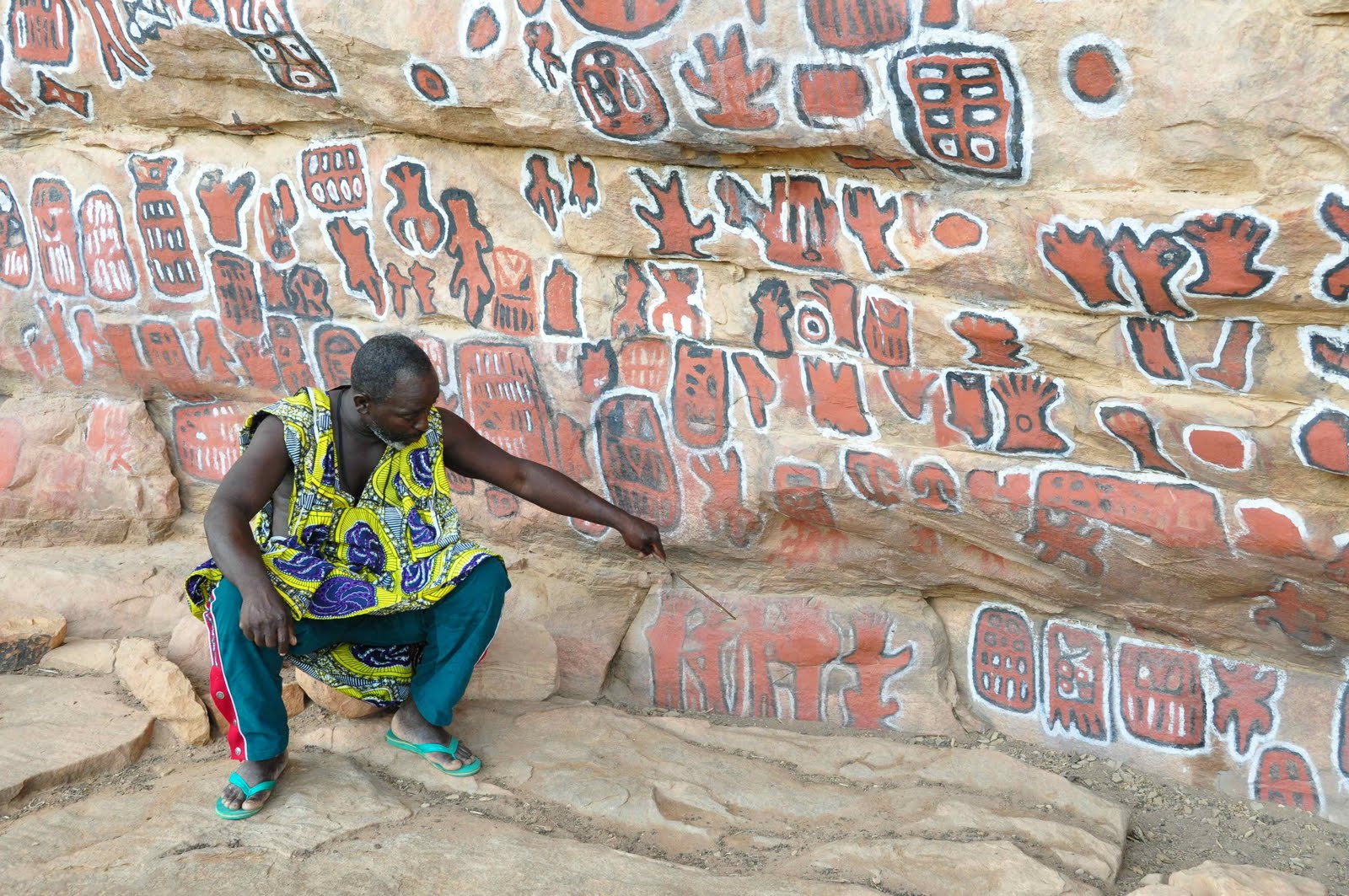
Dogon rock paintings - family 'tree'
It seems that the African woman is not allowed up to that area and that whether she is born in Africa or not. In the village there are two types of granaries, one with three openings for the women, and that stores only millet and another with one opening for the men, where groundnuts, beans and millet and other products are stored. 

Looking from up, it looks like a nice village. When you have to go through it then you notice the lack of drainage, garbage and animal droppings everywhere, stagnant water and a rather insalubrious set up. 


Case à palabre


Back at camp, they had a nap. The others got back shortly afterwards. It was much later that they were to learn that on their outing Hans was not feeling well and went for a malaria test at the local clinic. The test did not show any apparent signs of malaria but the doctor advised that he should start the course of pills immediately.

He had high fever and a bad headache too. He slept for the rest of the afternoon and it was only later in the evening that the fever abated. The manager of the hotel assured them that he was available in case of any need no matter how late it was. The local clinic also had a night service.

Next morning Hans still had the headache and was not looking too good. But later, he said his headache was better and we should be proceeding south. He assured everybody that he was ok to travel. So, they packed up and took the scenic road to Bankass.